

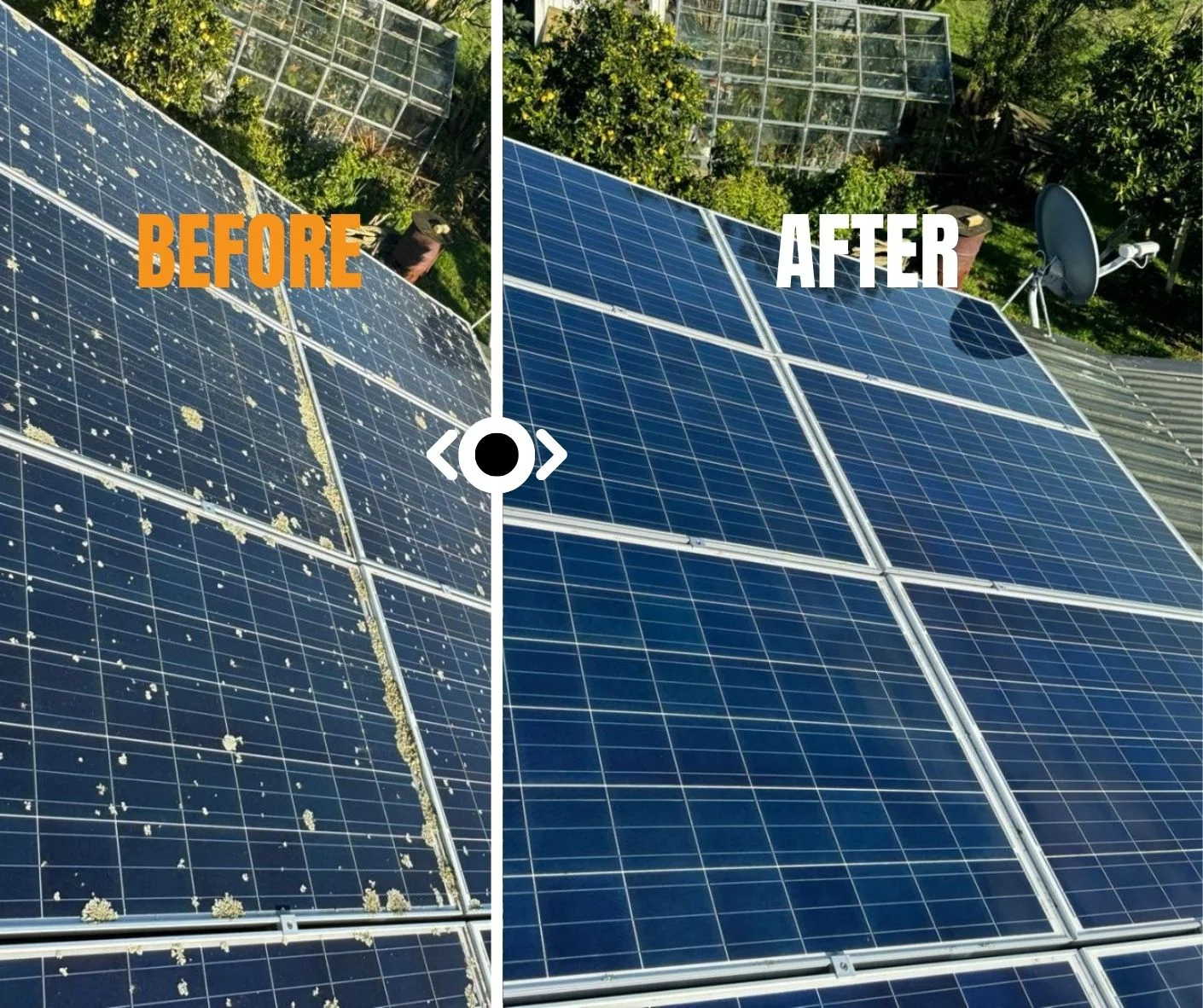
Lichen is the most damaging thing we find on New Zealand solar arrays. Unlike dust, which rinses off, lichen bonds to the glass and the frame, blocks light completely where it grows, and spreads every season you leave it. It is also the one problem that gets meaningfully more expensive the longer you wait.
If you can see grey-green crusty patches on your panels from the ground, you already have an established colony. Here is what it does, what it costs to deal with, and why the removal method matters more than most people realise.
Why lichen is worse than ordinary dirt
Dust and pollen sit on the surface and wash off. Lichen anchors into the glass and the frame edges, and that creates three separate problems.
- Complete shading and hot spots. A patch of dust reduces light. A patch of lichen blocks it. The cells underneath stop producing and begin dissipating heat instead, and a persistent hot spot permanently damages the cell. This is the difference that matters: soiling costs you output temporarily, lichen costs you the panel eventually.
- Etching. Lichen is mildly acidic where it grips. Left long enough it works into the anti-reflective coating, and the marks stay after the growth has gone. At that point the loss is permanent regardless of how well the panel is cleaned.
- It compounds. Lichen does not stay the same size. A few spots this winter is a colony in two years. The removal job grows with it, and so does the price.
Why New Zealand roofs get it so badly
Lichen needs moisture, mild temperatures and time. Most of the country supplies all three from about May to September. It is worst on:
- South-facing arrays, which get the least direct sun and stay damp longest after rain.
- Shaded roofs, particularly under or near trees.
- Low-pitch installations, under about ten degrees, where water sits rather than running off.
- Rural and bush-edge properties, where there are more spores in the air to begin with.
Coastal properties get a double hit: salt film holds moisture against the glass, which gives lichen a better foothold than it would otherwise have.
How to tell how bad yours is
From the ground, on a bright day, look for:
- Light growth. Scattered small spots, mostly around the frame edges where water collects. Usually dealt with as part of a normal clean.
- Moderate growth. Visible patches on the glass itself, several per panel, distinctly raised. This needs treating rather than washing.
- Heavy growth. Patches merging into each other, growth along most frame edges, colour visible from the street. Expect a treatment plus a second visit.
If your generation has dropped and you can see growth, the two are almost certainly connected. Compare this month against the same month last year in your inverter app rather than against last month, since seasonal variation will otherwise mislead you.
How not to remove it
Three methods do more damage than the lichen.
Water blasting. High pressure forces water past the panel’s edge seals and can crack cells outright. Most manufacturers specifically exclude pressure-washing damage from their warranties, and you will not discover that until a claim is declined. This is the single most common way we see panels ruined.
Scraping. Blades, abrasive pads and stiff brushes remove the lichen and the anti-reflective coating together. The scratches left behind create permanent shading of their own, so you trade a removable problem for an unremovable one.
Roof moss-and-mould chemicals. The products sold for concrete tiles and colorsteel are formulated for surfaces far more robust than solar glass. They can damage coatings and degrade the seals around the frame.
How lichen is removed safely
The method manufacturers actually recommend is unglamorous: treat it, wait, then lift it.
We apply a treatment that kills the organism so it releases its grip, rather than trying to force a living colony off the glass. Then we clean with reverse-osmosis pure water and brushes made for solar glass. Pure water has had its mineral content stripped, so it dries without leaving the spotting that tap water does, and it carries no chemical residue that would attract dirt back.
Heavy colonies often need a second visit. The treatment needs time to work, and pushing it in one pass is how glass gets scratched. If someone quotes you a single visit on a badly established array, ask what they intend to do about the bond.
Every job includes before and after photos and a written condition report, so you can see what came off and what state the panels underneath are in.
What lichen removal costs
Lichen is priced as part of the clean rather than as a flat add-on, because the work varies so much with severity. A lichen-affected panel takes roughly two to three times longer than a dusty one, which is what drives the difference.
Most New Zealand homes pay $275 to $395 including GST for a standard clean, and an array with established lichen sits at the upper end of that or above it depending on how far it has gone. The first clean on a neglected system is always the expensive one; the visits after it cost less because there is nothing left to establish. Full detail is on our pricing page.
We confirm the actual price before any work starts. If we get up there and find it is worse than it looked from the ground, we show you and let you decide rather than adding it to the invoice.
Keeping it from coming back
Lichen needs uninterrupted time to establish. Panels cleaned every twelve months do not give it that time, which is why regular cleaning works out cheaper than periodic removal. Shorten that to six months if you are coastal, shaded, south-facing or on a low pitch.
There is no coating or treatment that permanently prevents it in New Zealand conditions. Anyone selling one is overstating what it does. Regular cleaning is the whole strategy.
Frequently asked questions
Does lichen actually reduce solar output?
Yes, and more than equivalent dirt, because it blocks light completely rather than filtering it. How much depends entirely on coverage and where on the array it sits, since shading one cell can affect a whole string depending on the wiring.
Can I remove lichen myself?
Light growth on a panel you can reach from the ground, gently, with water and a soft brush, yes. Established lichen needs a treatment and time, and the temptation to scrub or scrape is exactly what damages the glass.
Will lichen damage be permanent?
It can be. Etching into the coating and hot-spot damage to cells do not reverse. Caught within a season or two, removal usually restores full output.
Is it covered by my panel warranty?
No. Warranties cover defects, not maintenance failures, and several explicitly require documented annual maintenance. Damage from water blasting or abrasives is excluded outright.
How long does removal take?
A standard clean on a lichen-affected array takes noticeably longer than a routine one, and heavy colonies usually need a return visit after the treatment has worked.
Not sure how bad yours is?
Send us a photo from the ground with a rough panel count and we will tell you honestly whether what you have is cosmetic or worth dealing with now. We service Auckland, Waikato, Bay of Plenty, Rotorua, Taupō, Whakatāne, Northland, Taranaki, Hawke’s Bay, Gisborne, Coromandel and Wellington.
Where lichen is worst: damp, shaded roofs grow it fastest. We see a lot of it around Hamilton, where river fog keeps panels wet, the lakes around Rotorua, the bush-backed towns of the Coromandel and the Bay of Islands. Find your area.
Get a free quote, or read more on how often to clean solar panels and why output drops.