

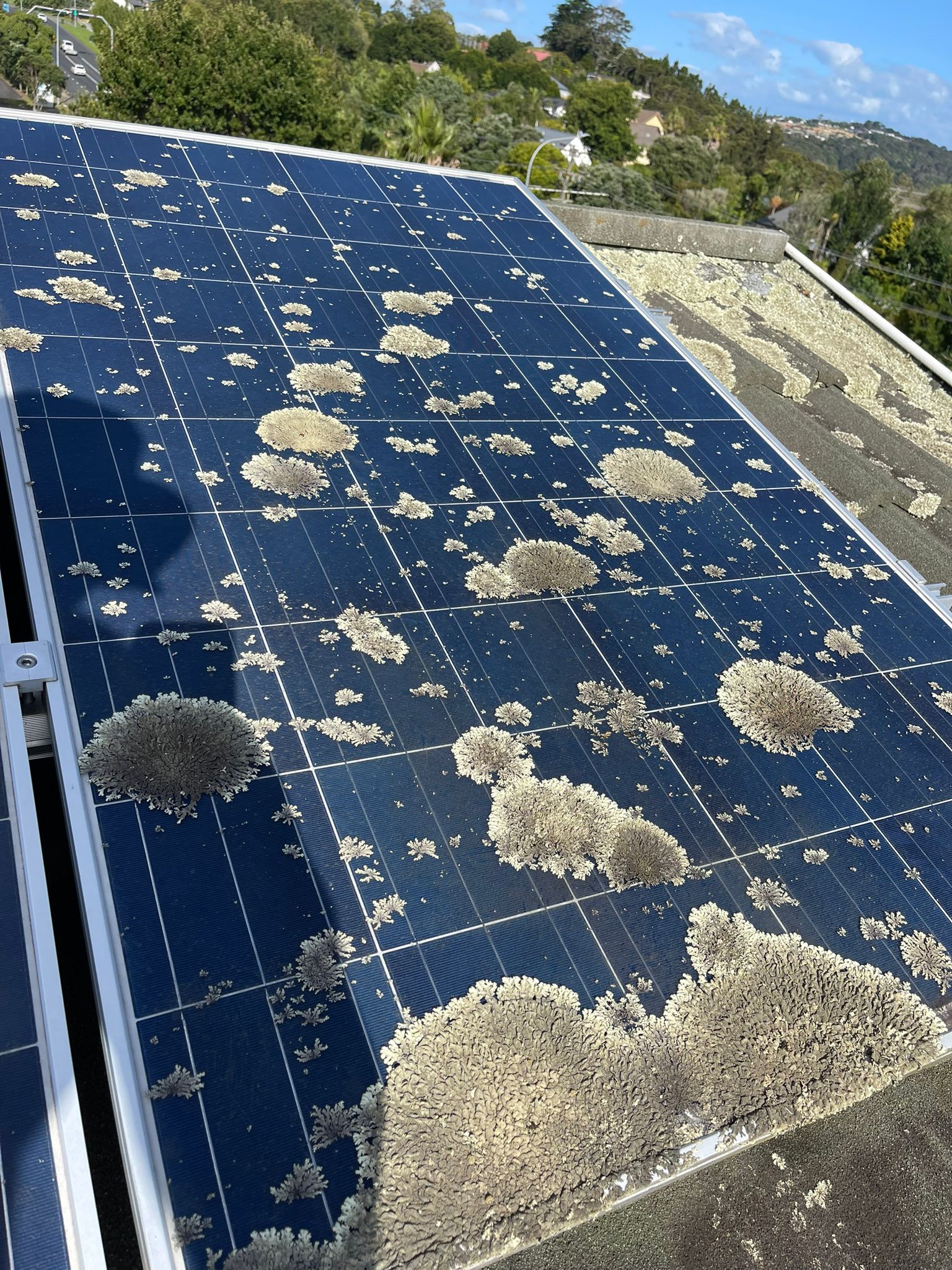
Lichen comes back because a clean only removes what’s already growing, not what’s about to. Spores and tiny fragments sit in the frame edges and on the roof right around your panels well before anything is visible on the glass. Get the panels done and leave everything around them alone, and the same patch of lichen is often back within a year or two.
We cover what lichen does to a panel and how to remove it safely in our main piece on lichen on solar panels. This one is about the bit that catches people out afterwards: why it grows back, how fast, and what actually slows it down.
Why does lichen come back so quickly?
Lichen doesn’t need much to get going again. It spreads as tiny spores and fragments carried on the wind and in rain splash, and most of them don’t travel far. They land on whatever is nearby, which after a clean usually means the frame edges you can’t fully reach, and the roof sitting right next to the array.
Two spots matter more than people expect.
- The frame edges. Water sits here longer than anywhere else on the panel, even straight after a clean, and it’s the hardest part to get completely clear. If there was any lichen on the array before, this is usually where it was holding on.
- The roof around and under the array. A clean deals with the panels. It does nothing for the tiles or iron right next to them, which on a lot of New Zealand homes are already growing their own lichen or moss. That surface sits a few centimetres from your panels and keeps reseeding them.
Shade, a damp roof and a pitch under about ten degrees all make this worse, for the same reasons they help lichen establish in the first place. If your roof ticks any of those boxes, expect regrowth to be faster than average.
How quickly does it actually come back?
Faster than most people assume. Edwin, who’s been cleaning panels since 2017, puts a number on it: never leave a clean longer than two years.
Even if you can’t see anything from the ground, he says there will be little spores starting to develop in the awkward places on the system well before that. Left longer than two years, those spores turn into growth that’s genuinely difficult to get out properly, and by then the lichen has usually started working into the panel’s seals.
That’s the part that makes lichen different to ordinary dirt. A dusty panel loses output until it’s washed. A panel that has carried lichen for years can be permanently marked underneath it, which is why Edwin calls it a silent killer of solar systems. Catching it within that two year window is what keeps it a cosmetic job instead of a panel damage job.
What does a treatment after the clean actually do?
A clean removes what’s sitting on the glass. A treatment goes further. It’s applied to slow the lichen down where it’s most likely to restart, rather than rinsing the surface and hoping it takes longer to come back.
Put simply, it targets the lichen itself rather than the panel. Where a plain wash leaves the glass clean but the conditions for regrowth unchanged, a treatment makes it harder for a new colony to establish in the same spot for a while afterwards.
We won’t put a number on how long that protection lasts. It depends on the roof, the climate and how exposed the array is, and we’d rather tell you honestly after we’ve seen your roof than quote a figure that doesn’t hold up for everyone. If a treatment is part of your clean, ask what it’s doing and why, the same way you’d ask what’s in any product before it goes near your panels.
Why does the roof around the panels matter so much?
Because most of the time, nobody is treating it. A solar cleaner looks after the panels. A house washer, if you’ve got one, is usually not getting right up next to the array. That gap between the two jobs is exactly where lichen keeps its foothold.
This is different to the hose-on moss treatments sold for roofing. Those are fine for tiles and iron generally, but they’re harsh on panel seals and the electrical parts around them, which is why we always say to keep them well clear of the array (our post on getting your roof washed when you’ve solar covers what to ask a house washer before they start). A roof treatment done properly around the panels is a different, gentler job, carried out by someone who knows exactly where the seals are.
If your roof is carrying visible lichen or moss near the array, treating the panels on their own is only solving half the problem. The other half keeps growing a few centimetres away, ready to recolonise the moment conditions suit it.
How common is this in our own jobs?
Common enough that we don’t treat it as unusual. Looking back at the solar panel cleans we’ve logged since 2023, roughly one in five also needed a separate lichen removal line on top of the standard clean. In some regions it’s closer to one in three.
It turns up most on damp, shaded and low pitch roofs, which is exactly why how often you clean, and whether a treatment is included, matter more than the brand of panel on your roof.
Common questions
Does every solar panel clean need a treatment afterwards?
No. If there’s no lichen on the array and the roof around it’s clear, a standard clean is all it needs. A treatment earns its place once lichen has actually shown up.
Will a treatment stop lichen coming back for good?
No. There’s no coating or treatment that permanently stops lichen growing in New Zealand conditions. Regular cleaning, and treating it early when it does turn up, is what keeps it under control.
Can I treat the roof myself to stop it spreading to the panels?
You can treat the roof itself with products made for roofing, but keep the spray well away from the panels. Hose-on moss treatments are harsh on panel seals even from overspray.
How do I know if I need a treatment or just a clean?
If you can see grey-green patches from the ground, or it has been close to two years since the last clean, ask for a treatment to be part of the visit rather than waiting to see.
Does lichen on the roof around the panels affect my warranty?
Not directly, but lichen on the panels themselves can. Edwin says the panel and inverter warranties he reads all ask for a yearly check, so staying ahead of it protects the warranty as well as the output.
Why not just clean more often instead of treating?
More frequent cleaning helps, but it doesn’t deal with the reservoir sitting on the roof beside the array. A treatment and a sensible cleaning interval work together rather than one replacing the other.
Keeping it from coming back
The short version: clean within two years, don’t wait for it to be visible, and get the roof around the array looked at if it’s carrying its own growth. See our solar panel cleaning service, check what a clean costs, or get a free quote and we’ll tell you honestly whether yours needs a treatment or just a wash.