

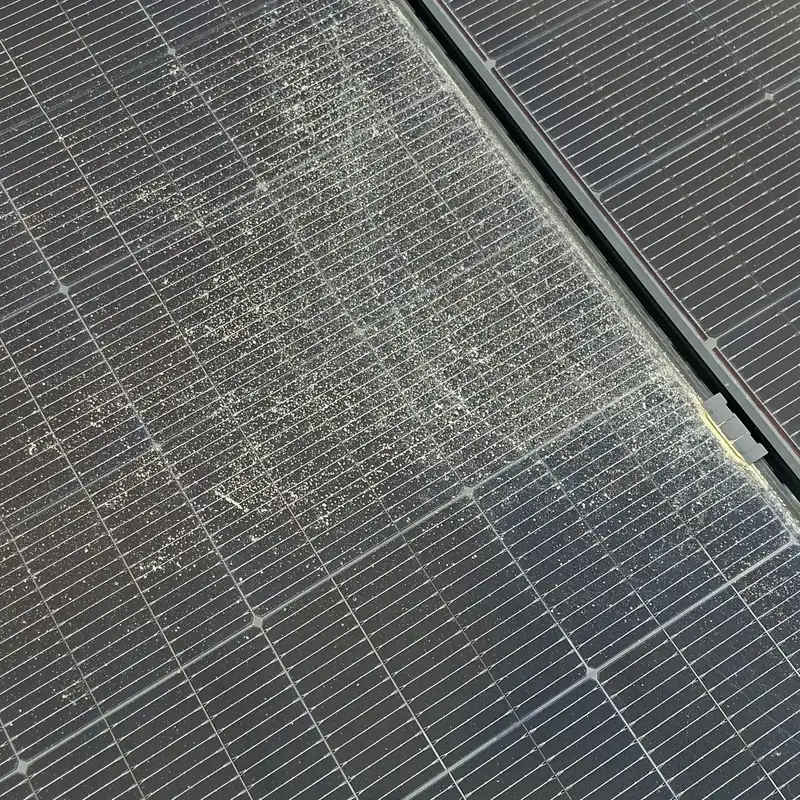
Rain moves loose dust and light dirt off your solar panels, but it’s not a clean. It takes away what was never going to cause much trouble anyway, and leaves behind a thin film from everything that was dissolved or stirred up in the water on the way down. Bird droppings, lichen and moss don’t move at all.
If you’ve been putting off a clean because it rained last week, have a look at the panels from the ground on the next sunny morning. Most people are surprised how dull they still look.
What does rain actually remove?
A decent shower shifts fine dust, pollen that hasn’t had time to set, and loose grit sitting on the surface. That part’s genuinely useful and it’s free, which is why panels in wetter parts of the country generally need less attention than panels somewhere dry and dusty.
What rain can’t do is scrub. There’s no brush and no pressure, just water running downhill. Anything stuck to the glass by its own weight, or glued on by sap, salt or old dust that’s already set, stays exactly where it is.
Why does a film build up anyway?
Every time it rains, a bit of whatever’s sitting on the panel dissolves into the water as it runs off. When that water dries, the dissolved minerals and fine dust don’t disappear with it. They’re left behind as a thin haze across the glass. One shower won’t do much. A winter of showers will.
You’ll often see it most clearly as a dirtier line along the bottom edge of the frame, where the last of the water pools and dries after everything above it has run through. We cover that line properly in why there is a brown line along the bottom of solar panels. For now, just know it’s a sign the panel’s been self-cleaning with rain for a while and nothing else.
If you’ve looked at a panel straight after heavy rain expecting it to look freshly washed, you’ve probably noticed the same thing we hear from other cleaners: it’s still dusty, the glass isn’t glossy, and the edges are often the grimiest part of the whole panel.
What rain never shifts
Bird droppings bake onto the glass within a day or two in the sun, and by the time it rains again they’re not going anywhere. Lichen grips onto the glass surface rather than sitting on top of it, and moss takes hold along the frame and backing edges where it stays damp the longest. Our guide to lichen on solar panels covers why it’s worth dealing with early. It’s a slow problem that gets harder to remove the longer it’s left on.
If birds are a regular visitor rather than a one-off mess, rain isn’t going to fix that either. Our bird proofing keeps them off the array altogether, which usually works out cheaper than having droppings cleaned off every few months.
Does the angle of your roof make a difference?
Yes. A steep roof helps rain do its best work, because water runs off fast and takes loose dirt with it. Panels mounted flat or at a low tilt, which you’ll see on some flat commercial roofs and ground-mount arrays, hold water much longer. That water sits, dirt settles out of it as it slowly evaporates, and the panel ends up dirtier than a steep one that got exactly the same rain.
Why some rain leaves panels dirtier than others
Rain isn’t clean water falling from a clean sky. It picks up whatever’s in the air on the way down, so panels near a busy road collect brake dust and exhaust grime, panels near farmland pick up dust and spray drift, and panels near the coast get a fine coating of salt with every bit of sea spray carried in. All of that gets rinsed off and redeposited with every shower, so a downpour in one of these spots can leave a panel no cleaner than if it hadn’t rained at all.
So how do you know when it’s actually time to clean them?
Edwin, one of our co-owners, puts it simply. The warranties are clear on paper: they all state an annual clean. In practice, most Kiwi homes can stretch that out. On a typical residential roof pitched between 15 and 30 degrees, a clean every one to two years is a safe ballpark. The signs to watch for are visual debris you can actually see building up, and a small, steady drop in output on your monitoring app.
Don’t reach for a pressure washer or a scrubbing brush to try and beat the weather to it. It’s the quickest way to cause micro cracks in the cells. Our guide to how often to clean solar panels in New Zealand has the full timing and cost detail.
Across the 500,000+ panels we’ve cleaned since 2017, systems that have only ever been cleaned by the rain are a common sight, and we’ve seen output improve by up to 30% on some systems we’ve cleaned.
Common questions
Does rain clean solar panels?
It rinses off loose dust and light dirt, which helps, but it leaves behind a thin film from whatever was dissolved in the water, and it does nothing for bird droppings, lichen or moss.
Is rain enough to clean solar panels on its own?
No. Rain is useful between cleans, especially in wetter parts of New Zealand, but it’s not a substitute for an actual clean. It has no way to remove anything that’s stuck fast or growing on the glass.
Does rain wash off bird droppings?
Not once they’ve dried. Droppings bake onto the glass within a day or two, well before the next shower, and rain just runs around them.
Does lichen wash off in the rain?
No. Lichen grips onto the glass itself rather than sitting loose on top of it, so water running over it does nothing. It needs to be physically removed.
Do flat solar panels get cleaned by rain?
Less than angled ones. Water sits longer on a flat or low-tilt panel, and dirt settles out of it as it evaporates instead of running straight off.
How often should solar panels be cleaned if it rains a lot where I live?
Rain buys you a bit of time but not a free pass. Most residential systems are still fine with a clean every one to two years, a little more often near the coast, a busy road or farmland.
Not sure if rain’s done enough?
Take a look at the panels from the ground next time the sun’s out after rain. If they still look dull, or you can see droppings, lichen or a build up along the edges, it’s time for an actual clean. See our solar panel cleaning service, or get a free quote.