

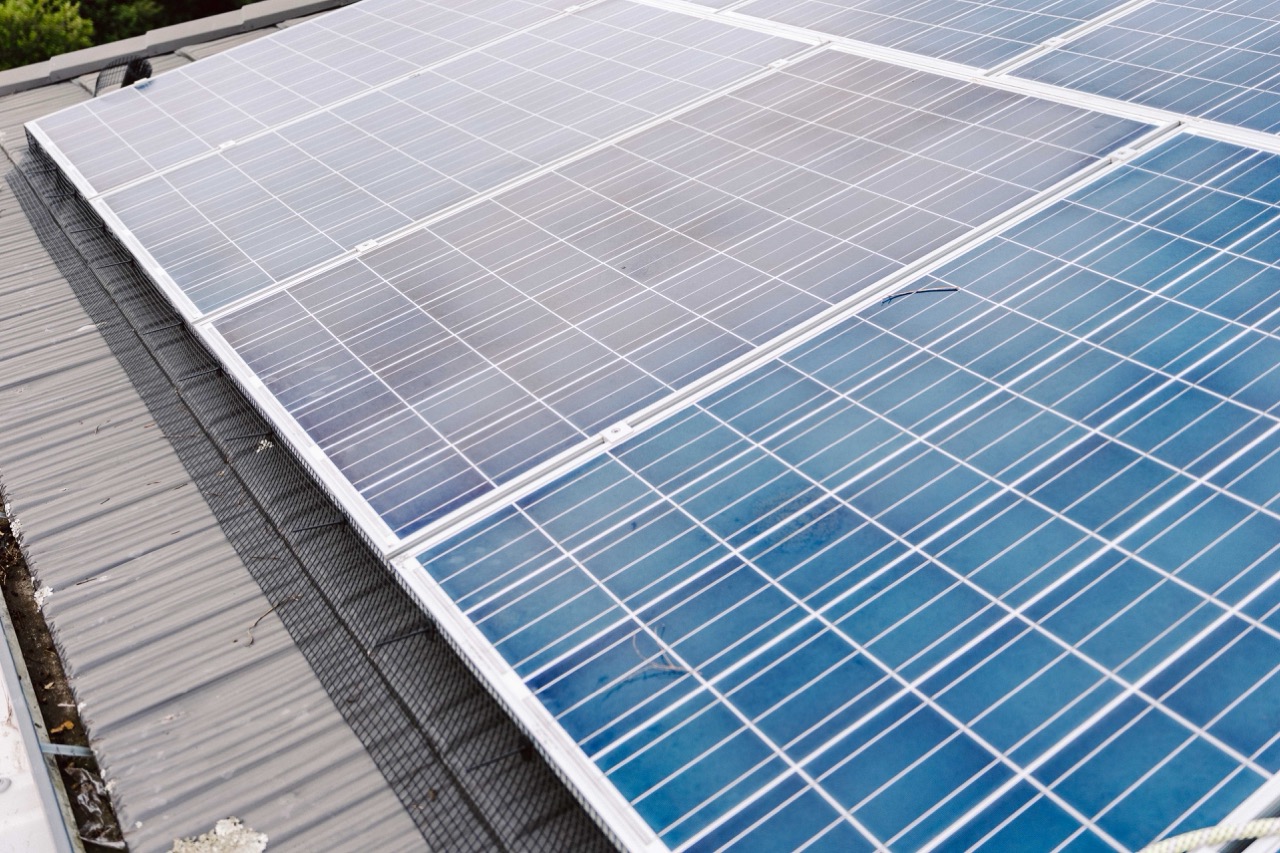
If something is nesting under your solar panels in New Zealand, it’s almost always a myna or a feral pigeon. Mynas build a big messy bundle of dry grass and plastic, chatter loudly and nest in spring and summer. Pigeons build a flat pile of twigs, coo, leave a lot of droppings and nest all year. Starlings and sparrows turn up now and then too.
The same mesh keeps all of them out. What changes is the clean-up, the timing and the price, so it’s worth knowing which one you’ve got before you ask for a quote. Here’s how to tell from the ground.
How to tell a myna from a pigeon
- Look at the bird. A myna is about the size of a blackbird, with a brown body, a black head, a yellow beak and a bare yellow patch behind the eye. You’ll see white patches on its wings when it flies. A feral pigeon is bigger and usually grey, with a shiny green and purple neck, though some are white or brown.
- Listen. Mynas are loud. You’ll hear squawks, whistles and chatter from first light, and the chicks screech for food. Pigeons coo, a low soft sound that carries through the ceiling.
- Look at the nest. A myna nest is a big tangle of dry grass, straw and plastic, often poking out from the edge of the panels. A pigeon nest is a flat, untidy platform of twigs and grass that builds up with droppings over time.
- Look at the roof and gutters. Pigeons leave piles of droppings on the roof under the array, in the gutter and streaked down the roof. Mynas leave far less. With mynas you’re more likely to see grass and straw sticking out from under the panels or sitting in the gutter.
- Think about the time of year. Mynas are busy from September to February. Pigeons can nest in any month.
One more pigeon to know about. The kererū, the big green and white native pigeon some people call a wood pigeon, nests in trees, not under solar panels. It’s protected, so if you ever think one is involved, leave it alone and check with DOC.
What about starlings and sparrows?
Starlings are dark and glossy with pale speckles, and their beaks turn yellow in spring. Like mynas, they nest in gaps and fill them with grass and feathers, and they live right through the country. Sparrows are small and brown and build an untidy ball of grass and feathers. Both can get through gaps a pigeon can’t, which matters when it comes to the mesh.
Which bird you get depends on where you live
Mynas only live in the North Island, north of roughly Whanganui and southern Hawke’s Bay. Winters further south are too cold for them, so you won’t find them in Wellington or anywhere in the South Island. Pigeons live from Northland to Southland, mostly in towns and cities.
Our own job notes back this up. When the crew writes down which bird they found, almost every pigeon job is in Auckland, across 21 different homes and businesses since 2023. Everywhere else, from Whangārei to Tauranga and Hawke’s Bay, the notes say mynas. In Auckland? Our Auckland bird proofing page has the local detail.
Does it change how you keep them out?
Not the method. Stainless steel mesh clipped around the edge of the array works for every one of these birds. What matters is the size of the holes.
A pigeon needs a decent gap to get through. A myna, starling or sparrow needs a much smaller one. Some products sold for pigeons have holes big enough for a myna to walk straight through. Our mesh has 12.5mm holes, which keeps all four out.
If you’re comparing quotes, ask what size the holes are in millimetres. Spikes, fake owls and shiny tape don’t close the gap under the panels, so they don’t work for any of these birds. Our bird proofing guide covers the mesh, how it’s fitted and what to avoid.
Does it change the clean-up?
Yes, and this is the biggest difference between the two.
Pigeons are messy. A pair raising one lot of chicks after another under the same panels builds up a thick layer of droppings on the roof underneath, and it washes into the gutters. Dried pigeon droppings can carry disease, so our crew wears masks and gloves for the clear-out, and the roof under the array gets cleaned and disinfected as well as the panels.
Mynas leave fewer droppings but much bigger nests. We pull out big bundles of dry grass and plastic, which block water draining off the roof and sit right next to the cabling.
Myna, starling and pigeon nests can all carry bird mites. When the chicks leave, the mites go looking for a new host, and if the nest is near a gap into the roof space, that can be you. Tiny biting mites inside the house in summer are a sign of a nest close by.
Droppings on the glass itself come off with a normal panel clean, which we do on the same visit.
When do mynas and pigeons nest?
Mynas start building in late August or September and lay from November to early February. They usually raise two lots of chicks a season. The eggs hatch after about two weeks and the chicks fly about 25 days later. Once they’ve nested somewhere, they’ll be back the next spring if they can get in.
Pigeons can nest in any month, though most eggs are laid in spring and summer. They lay two eggs at a time, the eggs hatch after about 17 days, and the chicks are flying at around a month old. A pair will often lay again while the last chicks are still in the nest, so there’s rarely a quiet patch.
That’s why timing matters. With mynas, the best time to mesh is late winter, before they start building. With pigeons, any time is the right time, because they don’t stop.
Is it birds, or rats and possums?
Scratching above the ceiling isn’t always birds. Birds are noisy at dawn and through the day. Rats and possums are busiest at night. If most of the noise is after dark, check the ceiling space and the garden rather than the panels. A nest under the panels can bring rats too, because the nesting material makes good shelter, so sometimes it’s both.
Does it change the price?
Pigeon jobs usually cost more. The mesh is the same, but there’s more to clear out, the roof under the panels needs cleaning and disinfecting, and the crew needs protective gear for the droppings. A myna job with a nest or two is mostly the mesh.
Across all the residential bird proofing jobs we’ve invoiced over the last two years, most cost between about $800 and $1,600 including GST, and a typical job comes in around $1,300. The other things that move the price are how much mesh your array needs and whether the roof is single or double storey. Send us a few photos of the roof and the nest and we’ll come back with a fixed quote.
Common questions
Do birds really nest under solar panels?
Yes. The gap between the panels and the roof is dry, sheltered and warm, and nothing can get at the nest. In New Zealand it’s mostly mynas and pigeons, with some starlings and sparrows.
Do pigeons nest all year round?
Yes. Most eggs are laid in spring and summer, but a pigeon pair can start a nest in any month.
How long do pigeons nest for?
About seven to eight weeks from laying to the chicks leaving: around 17 days on the eggs, then about a month before the chicks fly. Many pairs lay again straight away.
How long do mynas nest for?
About five to six weeks for each lot of chicks: around two weeks on the eggs and about 25 days until the chicks fly. The parents keep feeding them for another two or three weeks after that.
Can I just wait for the birds to leave?
Mynas are done by autumn, but they’ll be back in spring. Pigeons don’t really stop. Either way the nest and the droppings stay under your panels until someone takes them out.
Does the mesh hurt the birds?
No. It keeps them out rather than harming them. The important part is clearing the nest first, so nothing gets trapped underneath.
Not sure what you’ve got?
Take a photo of the bird or the nest from the ground and send it with your quote request. We’ll tell you what it is and what it’ll take to sort out. See our solar panel bird proofing service, or get a free quote.