

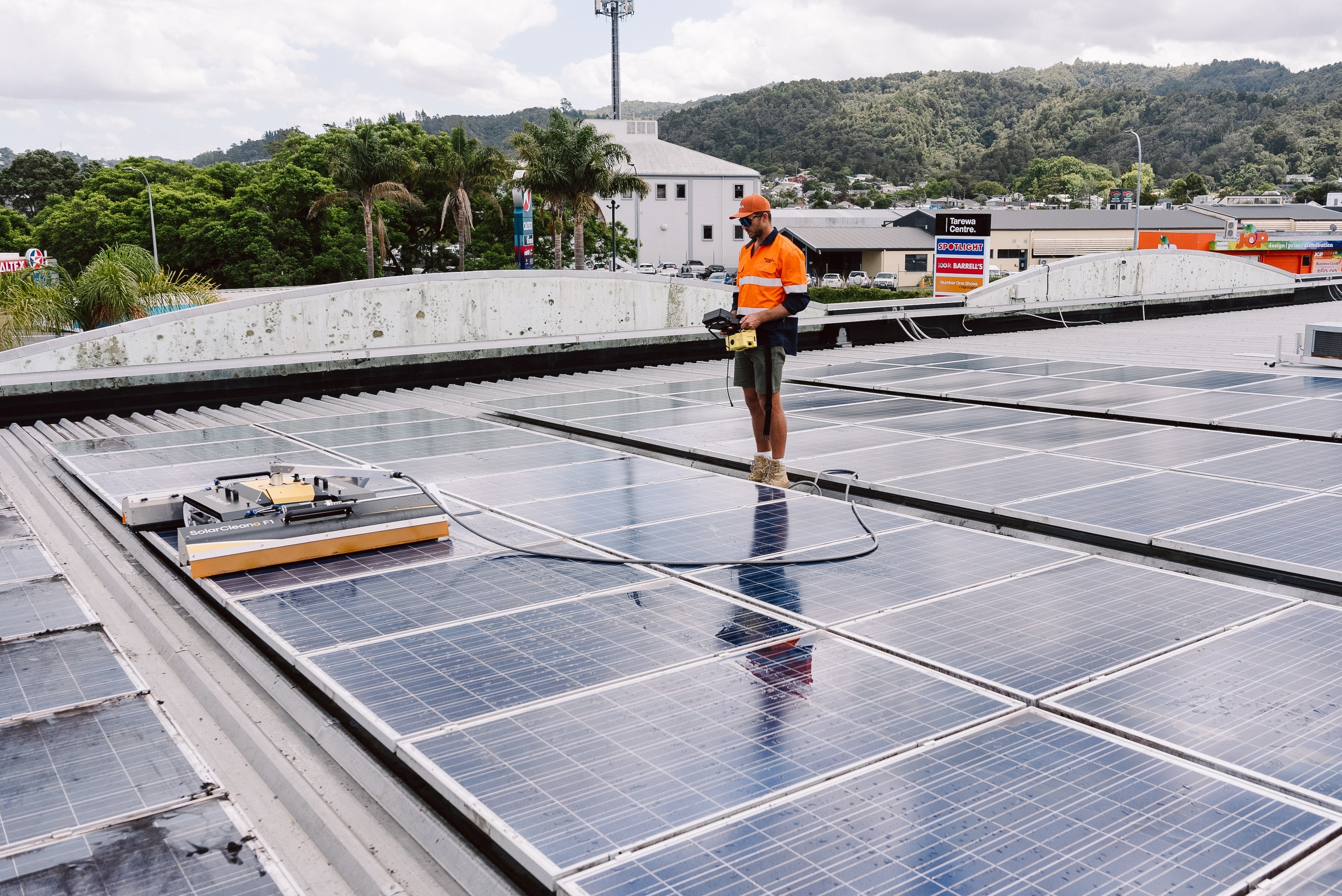
Most commercial solar systems in New Zealand should be cleaned every 6 to 12 months. Where your site lands in that range depends on four things: how close you are to the coast, what is in the air around you, the pitch of your roof, and whether birds have found the array. Get those four right and you have your cleaning cycle.
That is a shorter interval than most residential systems, and there is a reason for it. Commercial arrays are usually mounted on low pitch roofs, often 3 to 10 degrees. At that angle, rain does not rinse panels the way it does on a 30 degree house roof. Water pools at the bottom edge of each panel, evaporates, and leaves a band of concentrated grime that builds month on month. The industry calls it edge soiling, and it is the main reason a commercial array can look clean from the ground and still be down on output.
The four factors that set your cleaning cycle
Coastal exposure. Salt film builds on glass steadily anywhere within a few kilometres of the coast. It is thin, even, and easy to miss, and it scatters light before it reaches the cells. Coastal sites in places like Mount Maunganui, New Plymouth or the Auckland waterfront generally need the shorter end of the cycle.
What your neighbours put in the air. Industrial areas, motorway frontage, quarries, ports and rural processing sites all load the air with dust that settles on glass. A packhouse next to unsealed yard traffic can soil in months. An office park in a leafy suburb might barely soil at all.
Roof pitch. Below about 10 degrees, self cleaning from rain is close to zero and the pooling problem above kicks in. Flat mounted arrays should assume a 6 month check.
Birds. Gulls and pigeons treat large commercial arrays as home. Droppings are the worst form of soiling because they block cells completely rather than dimming them evenly, and a blocked cell can drag down the whole string.
Do not guess. Read your monitoring
The honest way to set a cycle is to watch your generation data. Compare this month against the same month last year, weather adjusted. Steady drift down of a few percent with no fault flagged is almost always soiling. If your monitoring platform shows string level data, soiled strings stand out against clean ones on the same roof. We cover what soiling actually costs in how much output dirty solar panels lose.
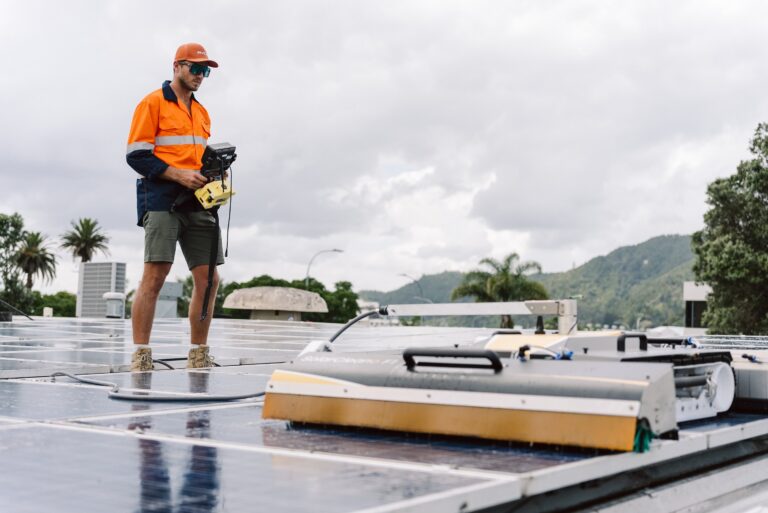
We put every commercial site we service on a cycle based on its actual conditions rather than a default. The first clean tells us a lot: how much came off, what kind of soiling it was, and what the inverter readings did afterwards. From there the interval is evidence, not guesswork. Read more about commercial solar panel cleaning or request a quote with your site details.
Common questions
Is twice a year overkill for a commercial system?
Not on low pitch coastal or industrial sites. On a sheltered, steeper roof in a clean airshed, annual is often fine. The monitoring data settles the argument either way.
Can rain keep commercial panels clean?
On low pitch commercial roofs, mostly no. Rain moves dirt to the bottom edge of each panel and leaves it there. It also does nothing about salt film or bird droppings.
Does cleaning frequency affect our panel warranty?
Some manufacturers require documented professional cleaning and inspection as a warranty condition. Check your warranty terms, and keep the reports. Every clean we do comes with a written report and before and after photos for exactly this reason.
Do you clean around our operating hours?
Yes. Early starts, weekends and staged cleans across multiple visits are all normal for commercial work. See how we work with Auckland businesses for the process.